
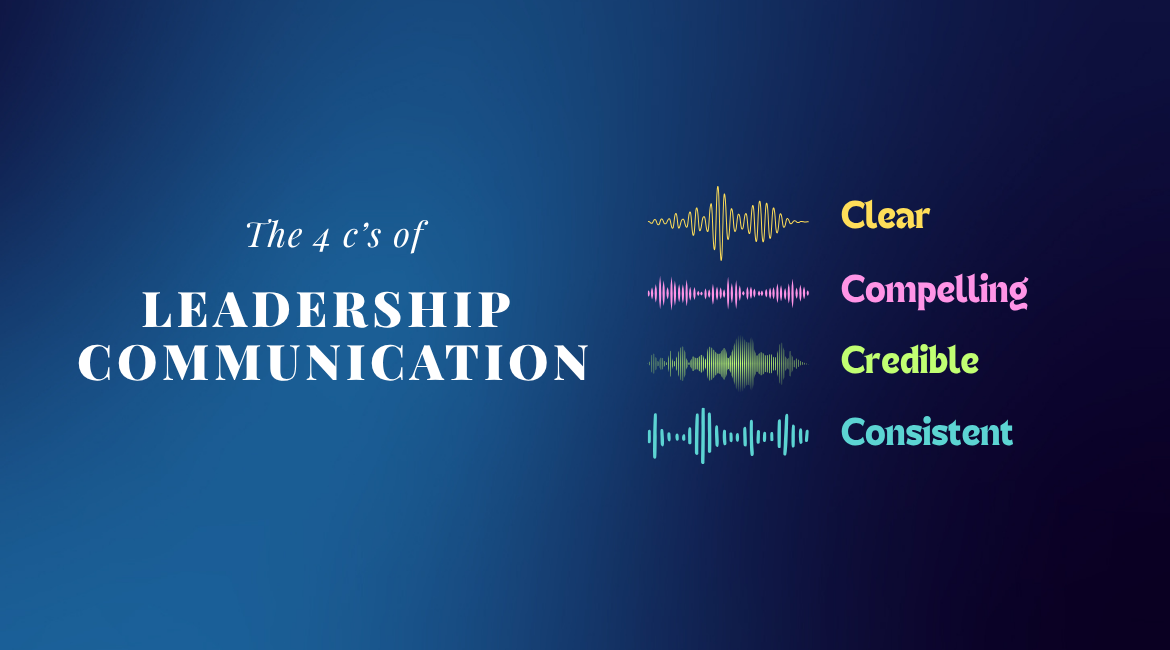
Leadership Communication: The 4 C’s of Leadership Communication
Leadership Communication: The 7 Essential Qualities Great Leaders Master
I once watched a CEO lose her entire leadership team in six months. Not because the strategy was wrong. Not because the company was failing. But because she could not communicate what actually mattered.
In every all-hands meeting, she buried the point under jargon. In every one-on-one, she spoke in abstract concepts instead of concrete direction. Her team spent more energy trying to decode what she meant than executing what she said. Eventually, they stopped trying.
You can have the best strategy, the strongest team, and the clearest vision. But if you cannot communicate effectively, none of it matters. People will not follow what they do not understand. They will not commit to what does not resonate. And they will not execute what you have not explained clearly.
Communication is not a soft skill. It is the mechanism through which everything else happens.
What Are the 7 Essential Qualities of Great Leaders in Communication?
When you study how exceptional leaders communicate, seven core qualities consistently emerge. These are not personality traits you are born with. They are capabilities you can develop through practice and coaching.
1. Clarity: Making the Complex Simple
Great leaders say what they mean without jargon, ambiguity, or unnecessary complexity. They make it easy for people to understand what is expected, why it matters, and what success looks like.
I worked with a tech CEO who could explain complex product architecture to investors in three sentences. His engineers thought he was oversimplifying. His board thought he was brilliant. The difference was clarity. He knew his audience needed the why and the what, not the how.
Clarity means eliminating the fog between your intention and their understanding. It means choosing precision over impression. It means testing whether your message actually landed, not just whether you delivered it.
How to Build This: After every important conversation, ask yourself: “Could they repeat back what I just said?” If the answer is unclear, your communication was unclear.
2. Authenticity: Leading with Your Real Self
People can tell when you are performing versus when you are real. Authentic communicators show up as themselves, not as some polished version they think leaders should be. Vulnerability creates connection. Scripted perfection creates distance.
Jacinda Ardern became a global leadership model partly because of her authentic communication during crises. She showed emotion. She admitted uncertainty. She spoke like a human being, not a politician. That authenticity built trust that scripted perfection never could.
This connects directly to one of the 7 pillars of coaching: trust. Without authenticity, trust never forms. Without trust, communication becomes transactional at best and manipulative at worst.
How to Build This: Stop editing yourself to sound like what you think a leader should sound like. Speak the way you actually think. Share the doubts alongside the decisions. People follow humans, not corporate personas.
3. Active Listening: The Foundation of Influence
Communication is not just talking. It is listening with intent to understand, not just respond. Great leaders ask questions, absorb answers, and adjust based on what they hear.
Most leaders are already formulating their response while the other person is still talking. Active listeners actually process what is being said, ask clarifying questions, and demonstrate understanding before moving forward.
This is one of the 4 types of leadership skills that separates transactional managers from transformational leaders. Managers tell. Leaders listen, then guide.
When Satya Nadella transformed Microsoft’s culture, he started by listening. He asked questions across the organization. He absorbed feedback. He adjusted his approach based on what he heard. That listening created buy-in that top-down mandates never could.
How to Build This: In your next meeting, track how much you speak versus how much you listen. If you are talking more than 50 percent of the time, you are not listening enough.
4. Empathy: Speaking to What Matters to Them
Effective communication requires understanding how others feel and what they care about. Empathetic leaders frame messages in ways that resonate with their audience’s values and concerns.
When Satya Nadella talks about Microsoft’s mission, he connects it to human impact, not just technology. He speaks to what people care about making a difference, solving real problems, creating opportunity. That is empathy in action.
Empathy is also one of the core elements of emotional intelligence in leadership. You cannot influence people if you do not understand what motivates them. You cannot inspire commitment if you do not connect to what they value.
How to Build This: Before communicating anything important, ask: “What does this person care about? How will this message affect them? What question are they actually asking?” Then adjust your message to answer those questions first.
5. Storytelling: Making Ideas Stick
Data informs. Stories inspire. Great leaders use narrative to make abstract concepts concrete, to build emotional connection, and to make their message memorable.
Steve Jobs did not say “Our new phone has a 3.5-inch screen and 8GB of storage.” He said “An iPod, a phone, and an internet communicator. Three devices. Are you getting it? These are not three separate devices. This is one device. And we are calling it iPhone.”
That is storytelling.
Stories work because our brains are wired for narrative, not bullet points. We remember stories. We forget statistics. If you want your communication to last beyond the meeting, wrap it in a story people can retell.
How to Build This: For every key message, ask: “What is the story that illustrates this?” Use real examples. Share what happened, what you learned, what changed. Stories make abstract concepts real.
6. Consistency: Building Trust Through Repetition
Your message should not change based on who you are talking to. Great leaders align what they say in private with what they say publicly. They repeat core messages until everyone can recite them.
When leaders tell one story to investors, another to employees, and another to customers, people notice. And when they notice, they stop believing anything you say.
Consistency is also one of the 5 C’s of coaching effectiveness: clients need to know you will show up the same way every time. Leaders need the same predictability. Your team should be able to predict how you will respond because you have demonstrated consistent values and consistent communication.
Amazon’s leadership principles work because Jeff Bezos repeated them relentlessly. Every decision referenced them. Every hire was evaluated against them. Every strategy anchored to them. That repetition created alignment across a massive organization.
How to Build This: Identify your three core messages. Then repeat them in every format, every meeting, every conversation until you are sick of saying them. That is when people are just starting to internalize them.
7. Follow-Through: Matching Words with Action
Communication without action erodes trust. Great leaders do what they say they will do. Their words and actions align. This consistency makes future communication more credible.
If you announce a new priority on Monday and ignore it by Friday, your team learns that your words do not matter. Do that enough times and they stop listening entirely.
This connects to one of the 10 leadership qualities of great leaders: integrity. Your communication is only as strong as your track record of following through. Words are cheap. Behavior is evidence.
How to Build This: Before committing to anything publicly, ask yourself: “Will I actually do this?” If the answer is not an absolute yes, do not say it. Better to under-promise and over-deliver than create credibility debt.
Why Most Leaders Struggle with Communication
Four traps consistently derail leadership communication:
Assuming Understanding – Just because you said it does not mean people heard it. Great communicators check for understanding, ask clarifying questions, and repeat key messages multiple times.
Prioritizing Information Over Connection – Leaders focus on what they need to say instead of what their audience needs to hear. Start with the audience, not the message.
Avoiding Difficult Conversations – Delaying tough conversations creates ambiguity and resentment. Address issues early when they are still small.
Over-Relying on Email – Email is efficient but terrible for nuance or emotion. Choose the right channel for the context. Complex topics need conversation, not email threads.
The 4 C’s of Leadership Communication
Effective communication follows four core principles:
- Clear – Eliminate ambiguity. Use simple language. Make your point explicit.
- Compelling – Earn attention. Connect to what people care about.
- Credible – Build trust through honesty and consistency.
- Consistent – Repeat key messages. Do not assume once is enough.
These principles mirror the 4 types of leadership approaches that drive results: directive when clarity is needed, collaborative when buy-in matters, coaching when development is the goal, and affiliative when connection is the priority.
What Does Leadership Coaching Look Like for Communication Development?
Leadership coaching is one of the most effective ways to improve communication. A coach helps you identify blind spots, practice new approaches, and get real-time feedback on how your message lands.
Unlike training that teaches concepts, coaching creates space to practice new behaviors and refine them based on what works. The goal of leadership coaching is not just awareness, it is behavior change.
If you are serious about becoming a more effective communicator, working with a coach accelerates the process. They hold up the mirror you cannot see on your own.
The ROI of Better Communication
Improving your communication has measurable impact:
- Teams with clear communication execute faster and make better decisions
- Employees who understand the why are more engaged and committed
- Leaders who communicate well build stronger relationships and higher trust
Communication is not overhead. It is the infrastructure that enables everything else. Invest in getting better at it, and every other aspect of your leadership improves.
Ready to Master Communication?
Take your leadership skills to the next level with our expert-designed courses. Join thousands of leaders transforming their careers.
Share:
In case you missed





Discover
Live Programmes
Work with Us
© 2026 The Skill Bridge, Bangalore 560103 · +91 9731661049
CPD-Approved · IFC GLC Listed · 🏆 Excellence in Leadership Education 2026