

Resilience gets misunderstood. People think it means being tough, grinding through pain, never showing weakness. That is not resilience. That is suppression. Real resilience is about bouncing back, not just powering through.
I watched a leader I admire go through a brutal year. Product launch failed. Key team members left. Board questioned her judgment. She could have hardened. Instead, she got curious. What could she learn from this? What needed to change? How could she grow through it instead of just surviving it?
That is resilience in action. Not pretending everything is fine. Acknowledging what is hard while staying committed to moving forward.
What Is Resilience in Leadership?
Resilience is your capacity to recover from setbacks, adapt to change, and keep going when things get difficult. In leadership, it is also about helping your team do the same.
Resilient leaders do not avoid challenges. They face them head-on. They do not ignore failure. They learn from it. They do not pretend to have it all together. They acknowledge struggle while maintaining forward momentum.
This matters more than ever in 2026. The pace of change is relentless. Uncertainty is constant. Leaders face pressure from all directions. Without resilience, you burn out. With it, you grow stronger through adversity.
The 5 C’s of Resilient Leadership
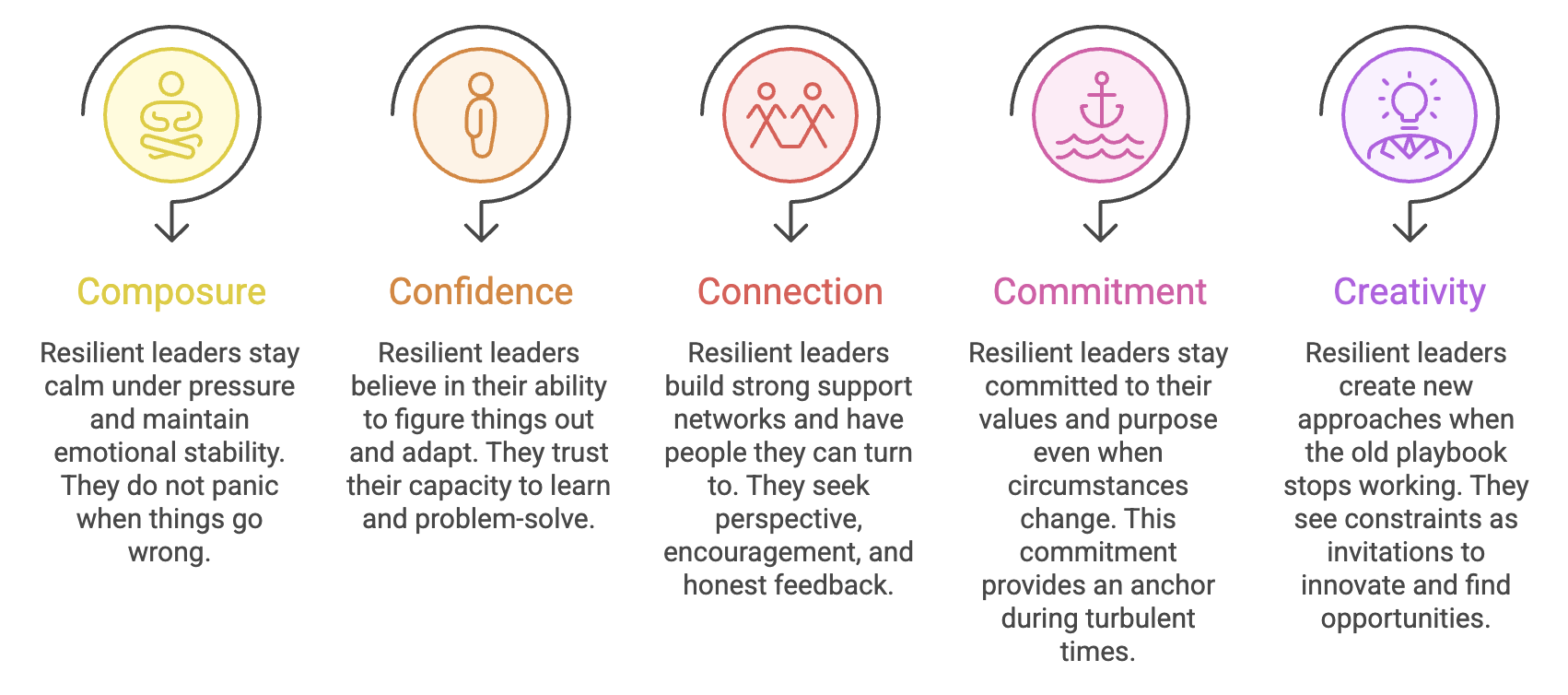
Resilient leaders share five core characteristics. These are not personality traits. They are capabilities you can develop.
1. Composure
Resilient leaders stay calm under pressure. They do not panic when things go wrong. They do not spiral when faced with uncertainty. They maintain emotional stability even when everything around them feels chaotic.
2. Confidence
Resilient leaders believe in their ability to figure things out. Not because they have all the answers, but because they trust their capacity to learn, adapt, and problem-solve.
3. Connection
You cannot be resilient alone. Resilient leaders build strong support networks. They have people they can turn to for perspective, encouragement, and honest feedback.
4. Commitment
Resilient leaders stay committed to their values and purpose even when circumstances change. This commitment provides an anchor during turbulent times.
5. Creativity
When the old playbook stops working, resilient leaders create new approaches. They see constraints as invitations to innovate. They find opportunities in challenges.
Building Resilience Through Practice
Resilience is a muscle you can strengthen through specific practices. Reframe challenges as opportunities. Build buffer in your schedule. Practice recovery. Celebrate small wins. Tell better stories about what is happening.
The leaders who thrive in the coming years will not be the ones who never face adversity. They will be the ones who know how to recover from it. Who build teams that can absorb shocks without breaking. Who create cultures where failure is learning, not shame.
That is the competitive advantage of resilience. It is what allows you to keep going when others give up. To stay creative when others panic. To lead with clarity when everything feels chaotic.
Ready to Master Resilience?
Take your leadership skills to the next level with our expert-designed courses. Join thousands of leaders transforming their careers.